Friday, October 30, 2015

Fly Fishing here and there , October 2015


This month things have slowed down and carp are not feeding at the same time I'm fishing for them.


 I went to The Bronx River to fish. I saw more large mouth bass than usual, which is good.


Looking west on the river.  Carp that were feeding were sucking things off the river bed


The river looked great you can sight fish for carp here.  They will take egg patterns too.


A lone carp suspending in the river. Bass and panfish could be seen suspending in bunches
up and down the river.


This lake has carp but was covered in algae during a hot sunny day at Crystal Lake in New Jersey.


Looking east

another view from the west side of the lake, messy!


I went to Dahnerts Lake for bass and carp.  Things were slow until  I saw a carp jump out of the water at the north end of the lake.  After I walked to that part of the lake; I was really surprised to see  more than a dozen carp, of varying sizes, feeding.  I ran back to my spot to get my gear and my fly rod.  When I returned to where I saw carp they were still there.  But slowly one by one, the pod moved and swam away.  They never returned.

 A young Bronx River large mouth bass on a green weenie


The eastern end of the Bronx River


A few Canada geese doing nothing but standing around on the river.


Perch are in the Bronx River too.  This one took a small white woolie bugger.


Me and "Two Rods" went to Clove Lake .  We saw signs of carp but only caught catfish.


"Two Rods" catching two catfish at a time with bread.

Wednesday, October 14, 2015

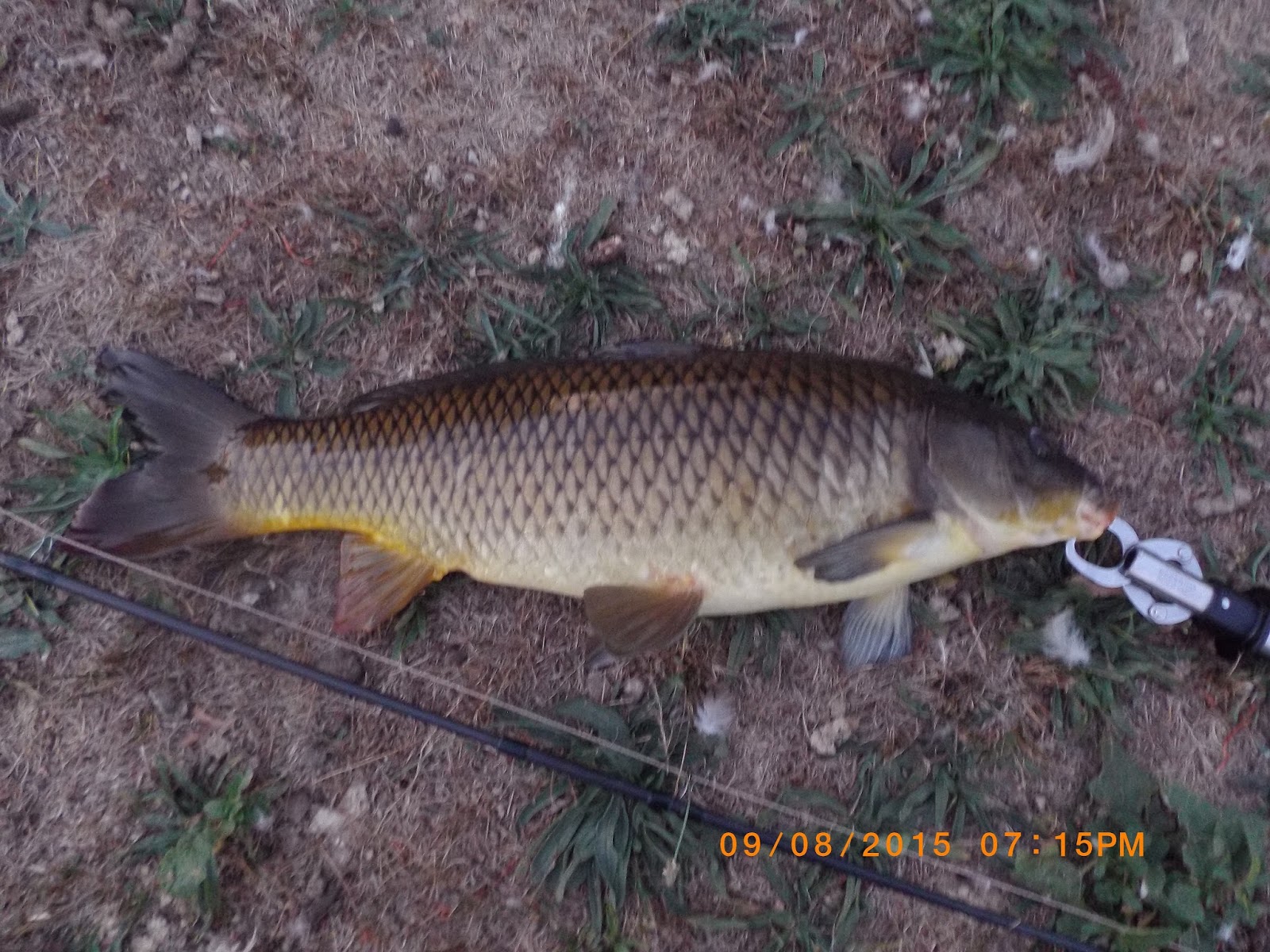
First carp on the fly this fall


Sorry for poor quality of my photo but it was late in the afternoon and shadows were heavy.
I'm fishing in one of my favorite lakes for dry fly fishing.  At this time of the year the temperature
is cooler but fish are finicky.  They have been caught a few times and will take the time to inspect
your fly.  The koi are especially cautious.  I've seen them swim around my flies several times
and on the last pass turn and swim away.  I wish I knew what tips them off.


There was no wind when this carp took my fly.  It is intense because you can see where the
carp are clooping.  Many questions go through my mind as I watch my fly.  Should I recast the fly?
Should I leave it where it is?  Do I notice a feeding pattern?  Are my feet in the right position to make
an accurate cast?  I want my fly to land in an area no wider than a tea cup; putting my fly on the
table is not good enough.

Another reason I like this lake is that is that most of the time the water is clear and not dark.   Easy to
see a woolie bugger when it is being fished on the bottom.  Easy to use dog food as chum


Monday, September 28, 2015

Fly Fishing for the very last carp of the summer


Just like last year when I caught a thirty inch carp on the last day of summer, my goal was to
repeat my feat.  Unlike last year I was not fishing New Jersey's eighty mile long Passaic River.
The weather has cooled some, the temperature is no longer above above ninety degrees.
This time I fished a small lake.   No thirty incher but a nice carp for the day none the less.


The fish pictured above is a carp caught earlier in the month


These are the dry flies I've used this month to catch carp

Monday, September 14, 2015

Carp


When I arrived at the lake it was so hot that no one was sitting in my favorite spot and it is
shaded by two trees!  "Mad dogs and English men go out in the midday sun", is an old song
that needs to be updated to include those of us who fly fish for carp during the dog days of summer.
The month of August has been one of the hottest months on record.


My back pack was filled with a litter of water and a half gallon of lemonade as well as few hundred
flies.  Serious problems can develop if you do not drink lots of fluids on a hot summer day.  Normally I would have skipped fishing on a day like this.  However, the need to catch some carp made me throw
caution to the wind.


SCORCHING and humid were the conditions.  No one was fishing.  carp were feeding so I "man up"
and started to fish different flies.  As the afternoon passed I started to hook fish.  My 4X tippet was
not enough for the first fish.  I like to challenge myself by using tackle as light as possible.  For me the
sweet spot is a tippet that is close to eight pounds, unless there are weeds or I'm on a river.


A fishing buddy who makes pellet flies from "flip flops" had given me some of his flies.  They worked!
I felt I was in the groove now.  Carp were feeding on the dog food I had scattered on the lake surface
(remember less is more once they start to feed).  A carp really hammered a slow sinking fly ( a fly made from a kitchen sponge ).  The rod actually shook in my had as the fly was taken.


When I can catch a few good fish, It makes for an enjoyable, though hot, afternoon of summer
fly fishing for carp..

Thursday, September 10, 2015

Deer Hair flies for carp


I had a good evening.  Two carp were fooled by my deer hair flies.  I used an old 5/6 weight fly rod


Rather than tie my fly on the tippet with a non slip knot, I used a fly fish hook snap.  This device
allows for quick fly changes.  I  had stopped using the fly fish hook snaps because I had a big river carp pull the snap apart  once.  The  fly fish snap allows me to test different flies without having to tie on a fly.


Here is a close up picture of my deer hair pellet fly and the snap.


This rig works for carp in Central Park.  Two wax worm soft baits connected by a fly fishing
hook snap


Carp will take egg patterns when they are drag free drifted past feeding carp.


Saturday, August 29, 2015

Dry fly fishing for carp


I spent a few hours hunting for smallmouth bass and carp in the Passaic River.  I was surprised
that I saw few feeding carp in an area where I had caught a huge carp last September.


I quickly got back on a bus and rode to an access point near Woodland Park.  I did catch
a small smallmouth bass using my go to fly, a white woolie bugger but carp were not feeding
there either.


The next day started slow as I fished my white woolie bugger.  Carp were foraging  in the
shallow part of a lake.  Try as I might, cast after cast to feeding carp was ignored.
I was using a 3X tippet with a non slip knot.  Finally I had a take and the fish had me watching
my backing peel off my reel and then my tippet snapped.  The fish was gone.


I sat down and tied on a 2X tippet.  My assortment of fluorocarbon tippets is a few years
old and it may be time to throw out the old.  I hate losing fish but especially when the lose
is due to using equipment that has become old and brittle.


The change in tippet worked.  The next carp fought long and hard but was landed, photographed
and released.


The next fish was a beautifully marked Mirror Carp.  I was especially happy that I didn't lose
this fish.  I have caught a few mirrors each year but I have never seen markings like this.


The most exciting way to fish for carp is dry fly fishing for them.  The very first carp I ever
caught was taken on a deer hair fly that was about 30 feet away from where I stood on the
river bank.  Stealth, Patience and Accuracy must be used to catch carp while fishing with flies


Wednesday, August 26, 2015

Kettle Ponds fishing


For years I have used Google Maps to look for new places to fish.  I never fished Kingfisher Pond,
a kettle pond, before because I believed this to be a Preserve.


 Kingfisher Park is named for the bird that eats fish here.  Eibbs Pond on Staten Island
 is a kettle pond too.


There are frogs, turtles, bluegills and a few carp here.  While I was not able to see the carp
there was clear evidence that carp live here.  I witnessed a few "emergency blows" as carp
become aware of something they did not expect to encounter.


This pond is just as secluded as the other kettle ponds I 've fished.


Kettles are fluvioglacial landforms occurring as the result of blocks of ice calving from the front of a receding glacier and becoming partially to wholly buried by glacial outwash. Glacial outwash is generated when streams of meltwater flow away from the glacier and deposit sediment to form broad outwash plains called sandurs. When the ice blocks melt, kettle holes are left in the sandur. When the development of numerous kettle holes disrupt sandur surfaces, a jumbled array of ridges and mounds form, resembling kame and kettle topography.[1] Kettle holes can also occur in ridge shaped deposits of loose rock fragments called till.[2]
Kettle holes can form as the result of floods caused by the sudden drainage of an ice-dammed lake. These floods, called jökulhlaups, often rapidly deposit large quantities of sediment onto the sandur surface. The kettle holes are formed by the melting blocks of sediment-rich ice that were transported and consequently buried by the jökulhlaups. It was found in field observations and laboratory simulations done by Maizels in 1992 that ramparts form around the edge of kettle holes generated by jökulhlaups. The development of distinct types of ramparts depends on the concentration of rock fragments contained in the melted ice block and on how deeply the block was buried by sediment.[3]
Most kettle holes are less than two kilometres in diameter, although some in the U.S. Midwest exceed ten kilometres. Puslinch Lake in Ontario, Canada, is the largest kettle lake in Canada spanning 160 hectares (400 acres). Fish Lake in the north-central Cascade Mountains of Washington State, USA, is 200 hectares (490 acres).[4]

A kettle in the Isunngua highland, central-western Greenland
The depth of most kettles is less than ten meters.[5] In most cases, kettle holes eventually fill with water, sediment, or vegetation. If the kettle is fed by surface or underground rivers or streams, it becomes a kettle lake. If the kettle receives its water from precipitation, the groundwater table, or a combination of the two, it is termed a kettle pond or kettle wetland, if vegetated. Kettle ponds that are not affected by the groundwater table will usually become dry during the warm summer months, in which case they are deemed ephemeral.[