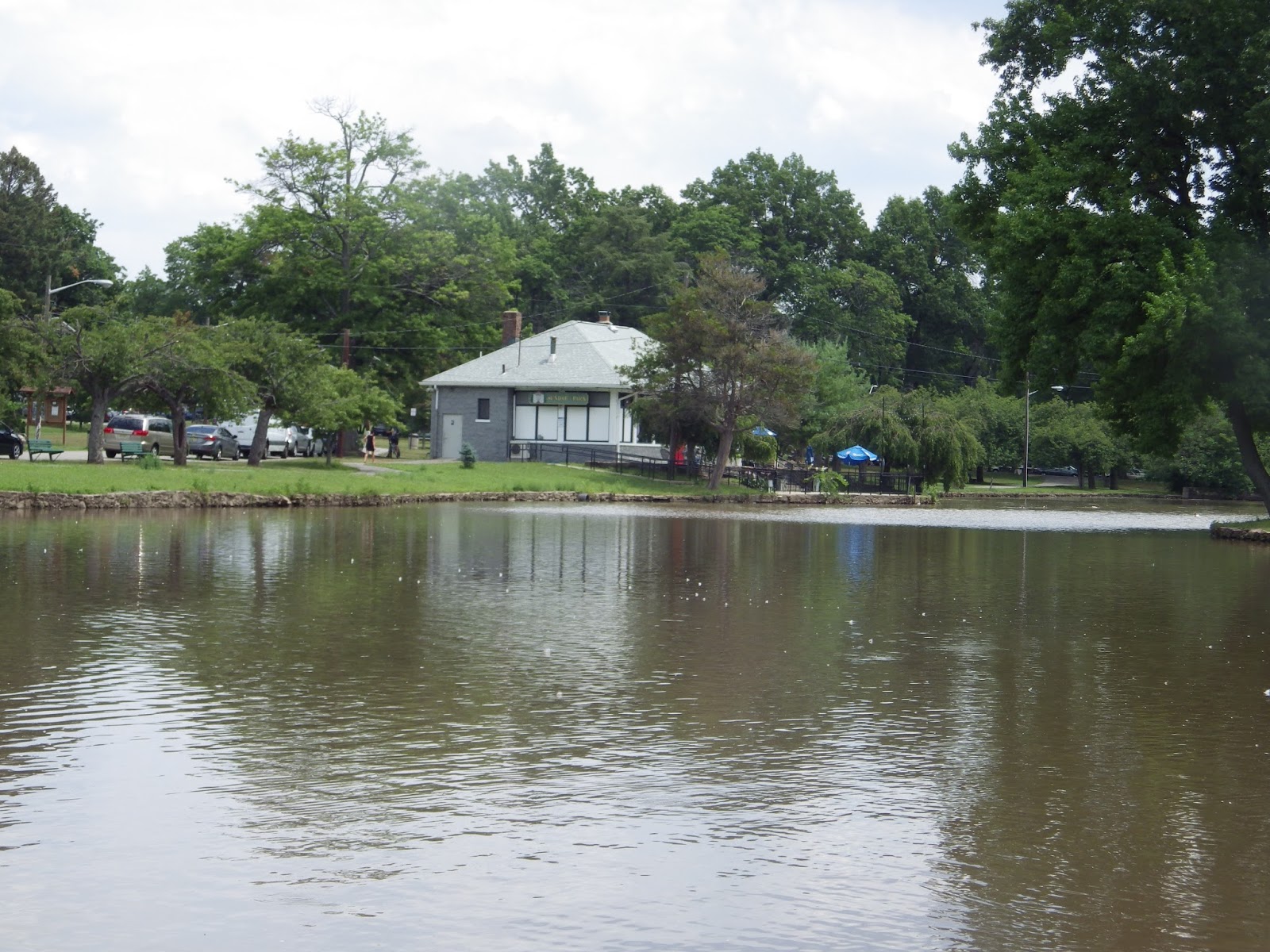
Tuesday, July 26, 2016

Carp


It is hot and humid but carp are tailing in the shallow water.  These are the young fish most less than five pounds.


They are fun to catch because they fight so hard in the shallow water.  A fight of five minutes or more is common.  And having a net makes it a little easier to bring them in.


My net man left to eat dinner so I was left to use my Boca grip.  I used my new fifty dollar
fast flex rod from China.  E-bay offers a number of these travel fly rods.  They are not terrible.


This fish took a dry fly after I had chummed him up using dry dog food as chum.
I lost the first two I hooked on dry flies due to the hook pulling loose. So I hooked a total of six
and landed four this evening.


This is my sixth hundredth post to my blog.  Thank you for reading about my adventures!

Friday, July 22, 2016

Fishing for carp with a Cane fly rod


One of the true joys of fly fishing is fishing with a rod made from natural fibers.  When I fish with a
cane or bamboo fly rod I need to remind myself to let the rod do its job.  There is no reason to "muscle" the rod to get it to perform correctly.  There are times and places to use a fast flex rod but
a slow flex rod is a thing of beauty when used correctly.


Carp here are tailing along the edge


The water here is muddy due to lake expansion work that is being performed in the adjacent
water.


Lost one and landed two.

Thursday, July 14, 2016

Cane Fly rod and Carp


I finally landed a fish.  This is the first carp of the summer for me.  I hooked two the other
day but lost them both( long distance release). An egg pattern on the bottom was used.  I landed
a second fish after my camera stopped working.  The cane was a lot of fun to watch as it
bent to accommodate the carp's resistance.


The weather now is hot and humid.  Finding a cool place to catch fish is the order of the day.
I usually start my fishing by drinking a quart bottle of Powerade.  I'm partial to it because It was being served when I trained at the Colorado Springs Olympic Training Center in 1995.  At that
 time the drink was made with fructose.  Now they use the cheaper fructose corn syrup.                                    


This lake is unique in that it holds lots of carp.  You can sight fish here and use other methods
to catch carp.  On a good day you can catch more than 10 carp.  There are at least a half-dozen koi
on the premises.  All different.  My favorite has tiger markings!


The problem now is that the parks department wants to improve the lake by draining  and
dredging the lake.  Probably they will try to reintroduce large mouth bass.
I believe that they should keep it the unique destination it is by maintaining carp as the dominate species.  Both fly fishers and conventional fishers fish here because of the carp.


Waiting for the train back to New York City.

Tuesday, July 12, 2016

Barbour Pond


My string of fishless days continues with me looking for new places to catch carp.


I have not fished here in years.  There are panfish,which includes largemouth bass.


Summer flowers


I always like this view of the pond. It is about 30 feet above the water.  Not a place to try and catch a bass but a really great view.


Dave Waks Memorial Park (formerly known as Barbour Pond Park) is located in the township of Wayne, NJ. It was renamed Dave Waks Memorial Park as a tribute to a former mayor of Wayne who passed away in 2007.


Barbour Pond was created by impounding part of the 8.9 mile Preakness (Singnac) Brook via the Barbour Pond dam. The brook is a tributary of thePassaic River. It’s watershed is located almost entirely in Wayne. The headwaters, located in the nearby High Mountain Nature Preserve, are considered to be trout production and are classified as C1. C1is one of the highest classifications given to a stream in the state of NJ.  Preakness Brook enters Barbour Pond from Valley Road , where it ventures through (along with a tributary stream) a recently protected 17 acre woodland. Preakness Brook from Barbour Pond to its confluence with the Passaic River is non trout producing water 

Saturday, July 9, 2016

Carp on cane fly rod, Oakland Lake, Clove Lakes,Willowbrook Lake,


I have not been able to write about my travels due to the fact that I have not caught any fish
in awhile.  But I have been trying.


Every so often I like to use different rods to fly fish.  This is a nine foot , four piece, cane fly rod. I picked it up on eBay several years ago.  I thought it would be fun to use a rod with a slow traditional flex.  This rod came with two tips.  I have yet to determine why.  I guess I'll have to visit my local fly shop to find out the purpose of two tips.  I have caught carp with this too.  It fishes like fiberglass.


In my last post, I mentioned that there are a number of kettle ponds in New York City.  I hope before the end of the season I will have visited all of them.  The picture posted above is of Oakland Lake
it is a kettle pond not far from Golden pond.  I have fished here in the past.  There are panfish, pickerel and carp.  It is fed by a natural water source and is one of the few lakes that never freezes completely during the winter.


The drawback to this lake is the algae bloom which covers the lake in the warmer months.


In this photo, you can see that the surface is already half covered by algae.  It was a beautiful day to fish in spite of the algae.


This is a picture of Cloves Lake on Staten Island.  Notice the fog in the background.  I was trying to determine the feeding patterns of the carp in these lakes.  Cloves Lake Park has three lakes within it's
borders.


On a different day, the weather was sunny .  Still, I caught no carp.  I chummed but they would not come!


I caught a nice mirror carp in this lake years ago; while it was feeding under a Willow tree.


This is a picture of another lake  on Staten Island. It is next to the College of Staten Island.
Unfortunately, I spent hours here at Willowbrook lake and only caught two turtles.  I saw not one fish of any kind on this visit.


Another view of Willowbrook Lake, looking north.


Oops, I mixed in a photo of Martling Lake, one of the three lakes that are in Cloves Lake Park.
 I sat near a Mulberry tree here for hours trying to catch feeding carp.


This is the shallow end of Willowbrook Lake.  I saw this mother and her ducklings


This proves I have been out fishing but just not catching!

Sunday, June 5, 2016

Fishing Goose Pond


I stumbled upon this pond while searching for a bus route that would take me to Baisley pond.
I couldn't belive it when this small pond appeared on my Google Map.   Further investigation
revealed the there are fish here.  On my first visit I saw a koi but nothing else.  Goose Pond is one of six Kettle Ponds in  New York City.


A kettle (kettle hole, pothole) is a shallow, sediment-filled body of water formed by retreating glaciers or draining floodwaters. The kettles are formed as a result of blocks of ice calving from glaciers and becoming submerged in the sediment on the outwash plain. Another source is the sudden drainage of an ice-dammed lake. When the block melts, the hole it leaves behind is a kettle. As the ice melts, ramparts can form around the edge of the kettle hole. The lakes that fill these holes are seldom more than 10 m (33 ft)[clarification needed] and eventually become filled with sediment. In acid conditions, a kettle bog may form but in alkaline conditions, it will be kettle peatland.


Over the decades, Goose Pond lost its natural source of water and algae bloomed in it. Much of the surrounding park had also fallen in disrepair as the city failed to maintain the park. In 1996, the Jamaica Hills Community Association and Council Member Morton Povman allocated funding for the park. The restoration included draining and deepening, installation of a new clay liner and filtration system. Carp and bluegill sunfish were reintroduced to the pond, among other native wildlife. A new well provided water for the pond and an island in its center served as a wildlife sanctuary. Each fall, the park hosts Jamaica Family Day, a fair for local residents.

Saturday, June 4, 2016

Fishing Golden Pond


This season I want to fish more places in New York City.  So, I fished the first Kettle Pond
I ever fished in the city.  This pond has several species of fish but I come here to try and catch the carp.  I've never seen any big  fish here.  I think that is because of the size of this pond.


Normally I fish this side of the pond.  Today I chummed three spots where I know fish hold.


The lily pads are a new item here at the pond .  My  first fish ran to these lily pads and buried itself beneath them.  The worst thing you can do in a situation like that is to panic.  I've learned to stop fighting the carp in this situation.  I give it some slack line.  Often the fish relaxes too.   After a few minutes, I begin to slowly hand strip the fish back towards me.  Given the opportunity, the fish will help you untangle itself from the lily pads.


The swans are new to the neighborhood too.


Looking east to west


All carp I caught had to be navigated through this field of lily pads.  I fought the carp in the open areas and as they grew tired, I lifted their heads up so that they would not become caught in the pads.
And I proceeded to"float them" over the lily pads to the shoreline.


The carp were swarming in the area I baited with chum.  So much so that even the turtles
were not able to drive the carp out of the feeding zone.


It was still light so I wet my line again.  At this point, the carp were eating in such a frenzy that they were feeding on top of the water.  I hooked my second carp on a fly that resembled bread floating on the  surface.


I caught my third fish about ten minutes after I landed the second.  It was hot and heavy as daylight was leaving.  A small crowd had gathered as I pulled the third carp out of the water.   When I released the last carp I noticed how warm the water felt.  This may have contributed to the fish being so active.


All three carp fought hard but I believe that because of  experience I was able to keep control of the fish and not lose control of the carp.  This was not a cakewalk.  The carp wrapped line around things
they went beneath the lily pads etc.


One of the things that contributed to my success this evening was the fact that I had fished here a few days earlier.  I lost the first two fish that evening.  One fish took my softbait of waxworms and the second was able to loose my bread fly after it ran towards the pads


Kettles are fluvioglacial landforms occurring as the result of blocks of ice calving from the front of a receding glacier and becoming partially to wholly buried by glacial outwash. Glacial outwash is generated when streams ofmeltwater flow away from the glacier and deposit sediment to form broad outwash plains called sandurs. When the ice blocks melt, kettle holes are left in the sandur. When the development of numerous kettle holes disrupt sandur surfaces, a jumbled array of ridges and mounds form, resembling kame and kettle topography.[1] Kettle holes can also occur in ridge shaped deposits of loose rock fragments called till.[2]
Kettle holes can form as the result of floods caused by the sudden drainage of an ice-dammed lake. These floods, called jökulhlaups, often rapidly deposit large quantities of sediment onto the sandur surface. The kettle holes are formed by the melting blocks of sediment-rich ice that were transported and consequently buried by the jökulhlaups. It was found in field observations and laboratory simulations done by Maizels in 1992 that ramparts form around the edge of kettle holes generated by jökulhlaups. The development of distinct types of ramparts depends on the concentration of rock fragments contained in the melted ice block and on how deeply the block was buried by sediment.[3]
Most kettle holes are less than two kilometres in diameter, although some in the U.S. Midwest exceed ten kilometres. Puslinch Lake in Ontario, Canada, is the largest kettle lake in Canada spanning 160 hectares (400 acres). Fish Lake in the north-central Cascade Mountains of Washington State, USA, is 200 hectares (490 acres).[4]

A kettle in the Isunngua highland, central-western Greenland
The depth of most kettles is less than ten meters.[5] In most cases, kettle holes eventually fill with water, sediment, or vegetation. If the kettle is fed by surface or underground rivers or streams, it becomes a kettle lake. If the kettle receives its water from precipitation, the groundwater table, or a combination of the two, it is termed a kettle pond or kettle wetland, if vegetated. Kettle ponds that are not affected by the groundwater table will usually become dry during the warm summer months, in which case they are deemed ephemeral.[6]