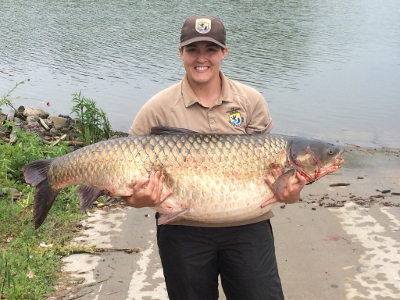
Ctenopharyngodon idella
(Grass Carp) Fishes Exotic |
Translate this page with
        |


USFWS 
Common name: Grass Carp
Synonyms and Other Names: white amur, silver orf; Ctenopharyngodon laticeps Steindachner, 1866, Leuciscus idella Valenciennes in Cuvier and Valenciennes, 1844, Ctenopharyngodon idellus
Taxonomy: available through 
Identification: Grass Carp is a large member of the minnow family with a body which is moderately compressed laterally. Its mouth is terminally located on a wide head and eyes are small and low on the head. It lacks barbels. It is olive-brown on the dorsal side, with silver sides and a white belly. Scales are large with dark edging. The dorsal fin origin is anterior to the pelvic fin origin and it has a short caudal peduncle. It differs from goldfish (Carassius auratus) and common carp (Cyprinus carpio) in having a shorter dorsal fin (only 7-8 rays) and from Hypophthalmichthys species (Bighead and Silver carps) in having fewer anal rays (9 or fewer) and fewer but larger lateral scales.
Distinguishing characteristics were given in Berg (1949), Shireman and Smith (1983), and Page and Burr (1991). Keys that include this species and photographs or illustrations were provided in most of the more recently published state and regional fish books (e.g., Robison and Buchanan 1988; Etnier and Starnes 1993; Jenkins and Burkhead 1994; Pflieger 1997).
Size: 125 cm.
Native Range: Eastern Asia from the Amur River of eastern Russia and China south to West River of southern China (Lee et al. 1980 et seq.; Shireman and Smith 1983).
  | |||
Virgin Islands | |||
Nonindigenous Occurrences:
Table 1. States with nonindigenous occurrences, the earliest and latest observations in each state, and the tally and names of HUCs with observations†. Names and dates are hyperlinked to their relevant specimen records. The list of references for all nonindigenous occurrences of Ctenopharyngodon idella are found here.
Table last updated 4/18/2018
† Populations may not be currently present.
* HUCs are not listed for states where the observation(s) cannot be approximated to a HUC (e.g. state centroids or Canadian provinces).
Ecology: Typical habitat includes quiet waters, such as lakes, ponds, pools, and backwaters of large rivers, and individuals generally do not travel long distances except for the annual spawning migration (Mitzner 1978; Nixon and Miller 1978; Bain et al. 1990). Nevertheless, there are reports of juvenile Grass Carp traveling as far as 1,000 km from their original spawning grounds (Stanley et al. 1978). Shallow water is the generally preferred habitat, although deeper waters are used when temperatures decrease (Nixon and Miller 1978). A number of experimental studies have reported environmental tolerances for Grass Carp. Fry and fingerlings have been reported to tolerate water temperatures from 0-40°C (Stevenson 1965; Vovk 1979), and Stevenson (1965) reported that fingerlings in small ponds in Arkansas survived 5 months under heavy ice cover. Chilton and Muoneke (1992) reported an upper lethal temperature range for fry as 33-41°C, and for yearlings as 35-36°C. Bettoli et al. (1985) documented a thermal maximum of 39.3°C and a preferred temperature of 25.3°C. Collee et al. (1978) reported that feeding declined sharply below 14°C. Nico et al. (2005) reviewed temperature tolerance of Grass Carp and the other Chinese carps.
Oxygen consumption (per gram of body mass) increases with higher water temperature and decreases with fish age and mass (Chen and Shih 1955; Wozniewski and Opuszynski 1988). The lethal low oxygen level for juveniles was <0 .5="" 1.05="" 1974="" 1990="" 1992="" 1993="" 6.0="" 6.5="" 9.24="" age="" ammonia="" and="" as="" be="" below="" carp="" concentration="" culture="" decreased="" deformation="" delayed="" determined="" egg="" egonovskaya="" fleit="" for="" grass="" hatching="" i="" iang="" increased="" larvae="" lethal="" low="" maximum="" median="" mg="" mortality="" occurred="" of="" p="" ph="" reported="" rudenko="" sensitivity="" the="" to="" ulyas="" wang="" was="" with="" zhang="">
Grass Carp appears to be tolerant of low levels of salinity, and may occasionally enter brackish-water areas. Fry (32-50 mm TL) survived transfer from freshwater to a salinity of 12 ppt (Chervinski 1977). Adults (2+ years) survived 10.5 ppt salinity for about 24 days and 17.5 ppt for 5 hours (Cross 1970). However, Grass Carp acclimated to 3, 5, and 7 ppt had an upper tolerance of about 14 ppt (Kilambi and Zdinak 1980). Maceina and Shireman (1980) showed that fingerlings reduce feeding at 9 ppt and stop feeding altogether at 12 ppt; thus, they predicted Grass Carpcould inhabit brackish water bodies up to 9 ppt. Maceina and Shireman (1979) reported that the species can tolerate 14 ppt for as long as 4 days, but that the upper long-term tolerance of fingerlings to saline waters was lower, about 10-14 ppt. Maceina et al. (1980) noted that oxygen consumption decreased along a salinity gradient of 0-9 ppt. Movement of Grass Carp from one river to another through a brackish-water estuary (Cross 1970) is not surprising given the species' tolerance to low levels of salinity. Avault and Merowsky (1978) reported food preference and salinity tolerance of hybrid Common Carp X Grass Carp.
Means of Introduction: Both authorized and unauthorized stockings of Grass Carp have taken place for biological control of vegetation. This species was first imported to the United States in 1963 to aquaculture facilities in Auburn, Alabama, and Stuttgart, Arkansas. The Auburn stock came from Taiwan, and the Arkansas stock was imported from Malaysia (Courtenay et al. 1984). The first release of this species into open waters took place at Stuttgart, Arkansas, when fish escaped the Fish Farming Experimental Station (Courtenay et al. 1984). However, many of the early stockings in Arkansas were in lakes or reservoirs open to stream systems, and by the early 1970s there were many reports of Grass Carp captured in the Missouri and Mississippi rivers (Pflieger 1975, 1997). During the past few decades, the species has spread rapidly as a result of widely scattered research projects, stockings by federal, state, and local government agencies, legal and illegal interstate transport and release by individuals and private groups, escapes from farm ponds and aquaculture facilities; and natural dispersal from introduction sites (e.g., Pflieger 1975; Lee et al. 1980 et seq.; Dill and Cordone 1997). Some of the agencies that have stocked grass carp in the past include the Arkansas Game and Fish Commission, the Tennessee Valley Authority, the U.S. Fish and Wildlife Service, the Delaware Division of Fish and Wildlife, the Florida Game and Fresh Water Fish Commission, the Iowa Conservation Commission, the New Mexico Department of Fish and Game, and the Texas Parks and Wildlife Department. The species also has been stocked by private individuals and organizations. In some cases, Grass Carp have escaped from stocked waterbodies and appeared in nearby waterbodies. Stocking of Grass Carp as a biological control against nuisance aquatic plants in ponds and lakes continues. For instance, Pflieger (1997) stated that thousands of Grass Carp are reared and sold by fish farmers in Missouri and Arkansas.
Status: Grass Carp have been recorded from 45 states; there are no reports of introductions in Alaska, Maine, Montana, Rhode Island, and Vermont. It is known to have established populations in a number of states in the Mississippi River basin. Breeding populations have been recorded for the Mississippi River in Kentucky (Conner et al. 1980; Burr and Warren 1986), the Illinois and upper Mississippi rivers of Illinois and Missouri (Raibley et al. 1995), the lower Missouri River in Missouri (Raibley et al. 1995), the Mississippi River or its tributaries in the states of Arkansas (Conner et al. 1980), Louisiana (Conner et al. 1980; Zimpfer et al. 1987), Tennessee (Etnier and Starnes 1993), and presumably Mississippi (Courtenay et al. 1991). It is also established in the Ohio River in Illinois (Burr, personal communication); it was listed as established in Minnesota (Courtenay et al. 1991, but see Courtenay 1993), and in the Trinity River of Texas (Waldrip 1992; Webb et al. 1994; Elder and Murphy 1997). Courtenay (1993) listed Grass Carp as established in eight states, Arkansas, Kentucky, Illinois, Louisiana, Missouri, Mississippi, Tennessee, and Texas; an additional one, Minnesota, was included in an earlier listing of states with established populations (Courtenay et al. 1991). Stone (1995) listed this species as being established in Wyoming; however, Stone (personal communication) clarified his earlier report by stating that, as of early 1997, there is no evidence of natural reproduction in that state. Similar to a few other authors, he used the term 'established' to indicate that grass carp populations have persisted for many years, presumably because of their long life span and because of long-term maintenance of wild populations through continued stockings. Pearson and Krumholz (1984) mentioned several records from the Ohio River, including river mile 963 on the Illinois-Kentucky border and from the Falls of the Ohio, at Louisville, along the Kentucky-Ohio border. They also stated that the species had been stocked in many private ponds and lakes in the Ohio River basin. Sigler and Sigler (1996) stated that this species is no longer found in Utah, but they provide no details. Harvest of Grass Carp by commercial fishermen in the Missouri and Mississippi rivers of Missouri has exhibited a general climb. In 1996, the most recent available data, there was a record reported harvest, about 44,000 pounds, 8 percent of the total commercial fish harvest (J. W. Robinson, personal communication). Starnes et al. (2011) report Grass Carp as stocked and occassionally occurring in the lower Potomac River and C&O Canal near Plummers Island. Chapman et al. (2013) provided evidence for successful reproduction of Grass Carp in the Sandusky River in 2011.
Impact of Introduction: Various authors (e.g., Shireman and Smith 1983; Chilton and Muoneke 1992; Bain 1993) have reviewed the literature on Grass Carp; most also discuss actual and potential impacts caused by the species' introduction. Shireman and Smith (1983) concluded that the effects of Grass Carp introduction on a water body are complex and apparently depend on the stocking rate, macrophyte abundance, and community structure of the ecosystem. They indicated that numerous contradictory results are reported in the literature concerning Grass Carp interaction with other species. Negative effects involving Grass Carp reported in the literature and summarized by these authors included interspecific competition for food with invertebrates (e.g., crayfish) and other fishes, significant changes in the composition of macrophyte, phytoplankton, and invertebrate communities, interference with the reproduction of other fishes, decreases in refugia for other fishes, and so on. In their overview, Chilton and Muoneke (1992) reported that Grass Carp seem to affect other animal species by modifying preferred habitat, an indirect effect. However, they also indicated that grass carp may directly influence other animals through either predation or competition when plant food is scarce. In his review, Bain (1993) stated that Grass Carp have significantly altered the food web and trophic structure of aquatic systems by inducing changes in plant, invertebrate, and fish communities. He indicated that effects are largely secondary consequences of decreases in the density and composition of aquatic plant communities. Organisms requiring limnetic habitats and food webs based on phytoplankton tend to benefit from the presence of Grass Carp. On the other hand, Bain reported that declines have occurred in the diversity and density of organisms that require structured littoral habitats and food chains based on plant detritus, macrophytes, and attached algae. Removal of vegetation can have negative effects on native fish, such as elimination of food sources, shelter, and spawning substrates (Taylor et al. 1984). Hubert (1994) cited a study that found vegetation removal by Grass Carp lead to better growth of Rainbow Trout (Oncorhynchus mykiss) due to increases in phytoplankton and zooplankton production, but it also lead to higher predation on Rainbow Trout by Double-crested Cormorants (Phalacrocorax auritus) due to lack of cover, and changes in diet, densities, and growth of native fishes. Although Grass Carp are often used to control selected aquatic weeds, these fish sometimes feed on preferred rather than on target plant species (Taylor et al. 1984). Increases in phytoplankton populations is a secondary effect of Grass Carp presence. A single Grass Carp can digest only about half of the approximately 45 kg of plant material that it consumes each day. The remaining material is expelled into the water, enriching it and promoting algal blooms (Rose 1972). These blooms can reduce water clarity and decrease oxygen levels (Bain 1993). In addition to the above, Grass Carp may carry several parasites and diseases known to be transmissible or potentially transmissible to native fishes. For instance, it is believed that Grass Carp imported from China were the source of introduction of the Asian tapeworm Bothriocephalus opsarichthydis (Hoffman and Schubert 1984; Ganzhorn et al. 1992). As such, the species may have been responsible indirectly for the infection of the endangered Woundfin Plagopterus argentissimus (by way of the red shiner Cyprinella lutrensis) (Moyle 1993). Wittmann et al. (2014) performed a meta-analysis of ecological effects of Grass Carp, finding an overall negative impact to biota (primarly through negative effects on macrophytes, with mixed results in other taxonomic groups) and an alteration of water quality (primarily change in conductivity and salinity) in stocked areas.
Remarks: In an article by Sandy Bauers of the Philadelphia Inquirer (1995), it is reported that Philadelphia is taking precautions to ensure that the release carp are sterile. The fish are sterilized by subjecting fertilized eggs to extreme heat or extreme cold. The result is a triploid fish rather than a normal diploid fish. Before the fish are shipped off to be stocked in area lakes, each specimen undergoes two mandatory blood tests by the US Fish and Wildlife Service and the diploid fish are removed.
DeVaney et al. (2009) performed ecological niche modeling to examine the invasion potential for Grass Carp and three other invasive cyprinids (Common Carp Cyprinus carpio, Black Carp Mylopharyngodon piceus, and Tench Tinca tinca). The majority of the areas where Grass Carp have been collected, stocked, or have become established had a high predicted ecological suitability for this species. Wittmann et al. (2014) used multiple machine learning methods to examine potential distribution of Grass Carp in the Great Lakes, finding suitable predicted habitat in all lakes but Superior.

No comments:
Post a Comment