The Blog of Fly Fishing in New York City's Parks. Currently there are more than two dozen fresh water lakes and ponds open to the public.
Monday, June 17, 2013
Fly Fishing Overpeck Creek - Part 2
I returned to Overpck Creek to inspect the west shore of the park. The lower west shore
has about a 3 miles long loop and has a series of well spaced fishing piers and decks.
The bridge in the picture allows one to cross the creek. I'm told Wallaye, bass, panfish and carp
are some of the fish here.
There is not much shore access here but if you are willing to bush wack there are places
where one can get into the water to fish.
It is a beautiful place to walk as there is a recreation path and benches for sitting and
clean rest rooms.
Here is a view of the east side of Overpeck Creek, just above the equestrian center.
Wild flowers are present
As I walked I saw this bed of wildflowers on the west side.
It was hard to decide which flowers looked more spectacular.
I had hope to see a bee pollinating the flowers
Can you see the bumble bee?
Thursday, June 13, 2013
Overpeck creek and Crystal lake Fly Fishing
Crystal Lake is another urban lake in New Jersey. The first thing I noticed were the koi.
There are at least three orange koi and one white koi in this lake.
The water here is crystal clear. I made a short stop here because I wanted to also see
Overpeck Creek which is about an hours walk south west of Crystal Lake.
There are 3 orange koi sunning themselves in the upper right hand corner of this photo.
At Overpeck Creek I found carp clooping while eating midges near the surface.
This was a complete surprise.
There were at least a dozen carp tailing and eating on the surface. I quickly rigged my
March Brown Fly Rod. I had my 6 wt, 7 piece, 8'6" rod. I bought this rod because it
is a faster rod.
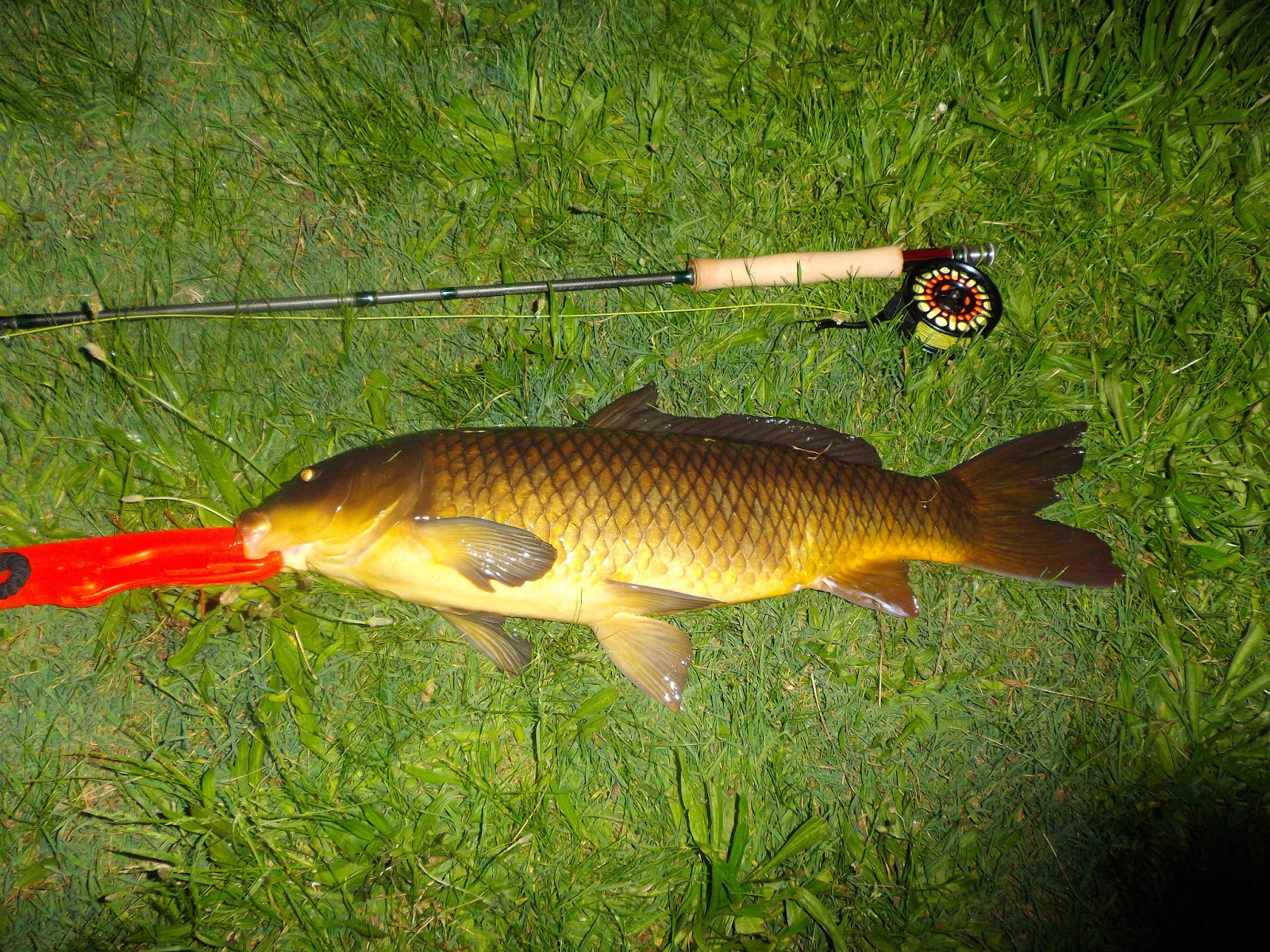
Once I put the rod together, I began to fish for the carp in this little cove. I hooked this
beautiful, rare Mirror carp.
From Wikipedia, the free encyclopedia
The upper creek flows through suburban communities west of New York City. The creek rises in Tenafly, on the west side of the Palisades, approximately 1 mile (1.6 km) from the Hudson River. It flows south-southwest through Englewood, past Teaneck, Leonia, and Palisades Park, where it flows past the Overpeck County Park. It joins the Hackensack on the south side of Ridgefield Park and the east side of Little Ferry.
In colonial times, the creek was called "Tantaqua" and was the site of a Hackensack (Native Americans) village. An attempted European settlement, Achter Col, in 1642 was aborted after Lenape retaliations for the Pavonia Massacre. Later 17th and 18th century settlements were collectively known as the English Neighborhood. The creek lay along the main land route west of the Hudson and provided a consistently difficult barrier for transportation in the area until the construction of modern roads and bridges in the 19th century. Development of the region was facilitated by the West Shore Railroad and the Northern Branch, latter of which partially runs parallel to the creek. Restoration of rail service is the object of the Northern Branch Corridor Project.
Like the other tributaries of the Hackensack in the Meadowlands, the creek has suffered from severe pollution in the 20th century during the era of heavy industrialization. During the 1950s, tide gates were installed on the creek that largely cut off the tidal flow into the surrounding wetlands. The restoration of the surrounding wetlands has been an ongoing project of several state and private agencies.
Saddle River
Last year I walked the Ho Ho Kus Brook, the west branch of the Saddle river. Now I plan to inspect the Saddle River's eastern branch. I'm looking for carp in the river in New Jersey.
I visited Otto C. Pehle Pond which is next to the Saddle River. It has Carp and other fish.
Note the green bush in the center of the photo. Can you see the ducklings sitting next to it?
If you can not see them look at the photo on top, which is a close up of the same area.
The Otto C. Pehle Pond looking south. A few seconds earlier a carp had jumped up in
the center of the pond.
The pond looking north. This area is windless and could hold fish.
Behind the Catholic High School I found a small pond that holds fish. It is on the east side of
the river.
I was surprised to find something like this here.
The lay out of the Saddle River park reminds me a great deal of the Bronx River Park as it flows through
Westchester county. Saddle River has a parallel, recreation path which allows cycling, jogging
and even roller skiing!
During my visit the Saddle river was very low But the next day it received 10 mm of rain
in one evening.
What I hoped to locate were pockets of water where fished hold. I did find some carp but not in the numbers I had imagined.
The Saddle River flows south through much of Bergen County, New Jersey. The river runs through densely populated suburban areas for much of its course.
The headwaters of the Saddle River are in the piedmont terrain of Rockland County, in southern New York state. Streams from this area flow south, forming the Saddle River at their confluence, two miles south of the New York state border, in the town of Upper Saddle River, New Jersey.
From its feeder streams in Upper Saddle River and the source in Airmont, New York, the Saddle River continues south for 16.3 miles, passing through the towns of Saddle River, Waldwick, Ho-Ho-Kus, Ridgewood, Glen Rock, Paramus, Fair Lawn, Rochelle Park, Saddle Brook, Lodi, Garfield, and Wallington.
The Ho-Ho-Kus Brook, a major tributary, joins the Saddle River at the Dunkerhook area of Saddle River County Park. Their confluence marks the border of four Bergen County towns: Ridgewood, Paramus, Glen Rock and Fair Lawn.
The terminus of the Saddle River is at Garfield and Wallington, where the waterway empties into the Passaic River. The Passaic River drains to the sea at Newark Bay.
The northern part of the Saddle River watershed drains an area between the Ramapo River watershed to the west, and the Hackensack River watershed to the east.
Fish species in the Saddle River include largemouth bass, pickerel, bullhead catfish, sunfish and different varieties of trout. Most of the trout are stocked by the New Jersey Division of Fish and Wildlife [1], although the uppermost reaches of the river and some of its tributaries hold wild brown trout. These wild trout are threatened by increased residential use of lawn fertilizer which contributes to algae and weed growth.
Saturday, June 8, 2013
Long Island fly fishing for Carp
I went to Rockville Center to look for new places to catch carp. I've fished some of the Rockville Center
lakes before. I caught a few rainbow trout , perch and a Brook trout! This time I headed south of
the Long Island Rail Road train station where two unexplored fisheries existed.
My first stop was at the Mill River park. I discovered that the water here is brackish and
I had arrived at low tide. There is not much to see at low tide but a careful inspection of
the shore line did show fry swimming at the water's edge.
Looking east
Looking south
Looking down at the fry swimming (they are about 2.5mm long).
My second stop was at Smith Pond, a large body of almost inaccessible water. I think
a kayak or some other type of boat is needed to fish this water. All along the shore were
aquatic plants and roots.
Here is an example of what it looks like. Only after you reach beyond 7 meters do you
find open water.
Here is a deck that is used for fishing but it is surrounded by lily pads and roots.
I had no choice but to get back on the train and ride to Argyle Lake. I hooked two small carp
here just a few days ago. Pictured above is the smaller south pond. I saw a small koi about
30mm long swimming frantically on the surface.
Looking south at the small pond
Looking east at pond number 2 and Argyle Lake, the larger body of water.
I also saw a koi I believe I caught two years ago in pond #2. I decided to go with the percentages
and fish for the common carp that were feeding further from shore. I did hook a fish and it ran like a freight train. It ran across the lake twice and tried to bury it self in some root system on the west side of the pond. I let the line go slack and waited to see if the carp would free itself. He didn't budge. Fortunately, I was able to walk to the west side of the pond and release the self imprisoned fish from the roots. As soon as he was free he ran again this time east.
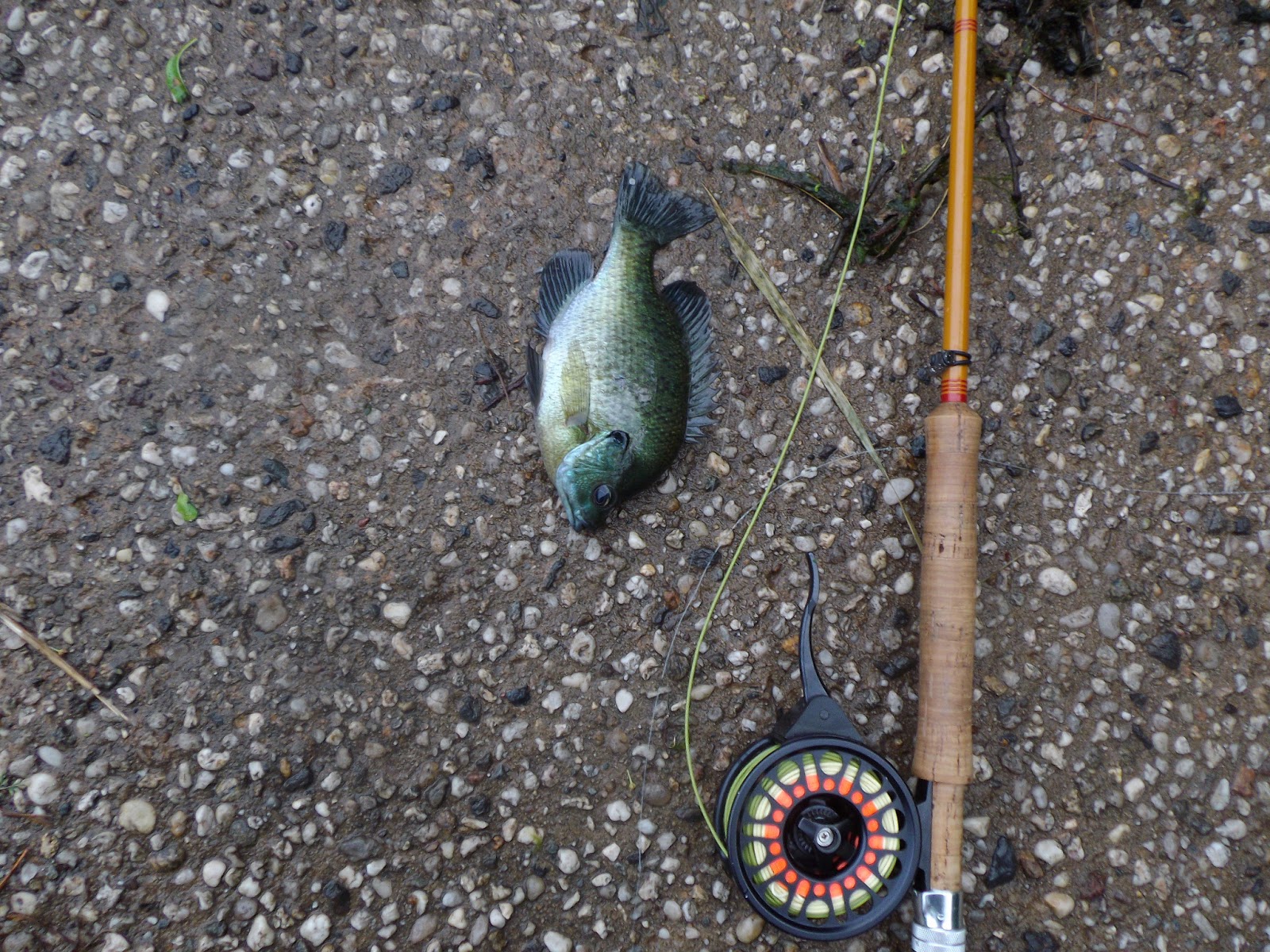
A few Bluegills and a Crappie
I sat for a few hours in a corner of Prospect Park Lake, chumming some cracked corn for carp.
Only one koi was spotted. After I left that location I began to fish with some of my favorite
flies, pheasant tails, zug bugs and flash back hare's ear. I like to start small so I used # 14.
As I walked the area known as the Lullwater, I started to fish using single hand Spey Casting
techniques. Fly Fishing in a New York City park does not allow for traditional back casting.
First I caught a few small bluegills ( less than 6"). There a few spots that I know hold bass and
crappie. I made several cast and then I felt a hit. I thought it might be a small bass. The fish resisted
my attempts to hand strip the line. I kept the rod tip down so I would not lose the fish. The fish
fought hard and tried to run. But I started to retrieve line. As my furled leader came near the rod tip
I raised the rod. I had hooked a 7or 8 inch crappie on a #14 hare's ear.
Sunday, June 2, 2013
Fly fishing for carp in New Jersey
It was a really hot day so I went to New Jersey to fish for carp. On days like this I like to sit
for awhile under a shady tree and drink a lot of cool liquids before I begin to fish.
Due to day light saving time and the sun setting later, I can fish until almost nine o'clock in the
evening. I hadn't intended to fish until dark but that is what happened. I arrived at the lake
after 3:00 pm. I used a #10 white woolie bugger. It was a brand new fly, so I let it float on
the water as if it were a dry fly. It looked like a piece of bread floating on the water. I wanted
to see if a carp would take it After about ten minutes I had a carp take the fly but I
was unable to set the hook. For the next three hours no fish.
I moved from the shallow end of the lake to an area where fish "cloop" as the sun sets. The water is
deeper there. Carp had begun to feed on the surface by the time I arrived. I had some dry
cat food to use as chum. I chummed in a way that allowed the wind to push the cat food
towards the "clooping" carp. As the carp detected the floating pet food, a feeding frenzy began.
I set up by putting on a #12 brown deer hair pellet fly. I made dozens of cast to feeding carp but it
was more like a game of "wack a mole". I could not get my fly to where the next carp rose
to eat from the surface. In fact, It looked like they could spot my fly and deliberately avoided it.
It was after 8:00pm and I wanted to take the 8:41 pm back to New York City.
My fly box is loaded with deer hair flies from #14 to #4 in different colors. So I changed to
a white # 12 deer hair. I allowed the fly to remain among the dry cat food floating on the surface.
Sometimes this will do the trick. I guess it was just before 8:30 when I saw my white fly disappear.
The fly line began to move smoothly across the lake; "fish on".
I've been using my new semi automatic the Peux Fulgor. It is surprisingly smooth and whisper quiet.
The only sound I could hear in the twilight was that of the 8:41 to New York City as it arrived
at the station across the street from the lake. It took minutes more before I was able to bring
the head shaking carp to hand. By the time I had packed up my rod it was nearly nine o'clock.
The next train to New York came at 9:30 pm.
Friday, May 31, 2013
Long Island Carp
Went to a different pond. This one is in Lindenhurst, Long Island. It is small but I saw a few
feeding carp along the shore line.
The pond has an aerator which is unusual for the New York ponds that I fish. But it means
the water will have less algae when the summer heat arrives.
Aerator working at Feller's Pond
Looking north
After I left the pond I traveled to nearby Argyle lake in Babylon, New York. I have fished Argyle
a number of times
There are three bodies of water in this area. The main lake which is stocked with trout
and two smaller ponds south and west of the lake. I caught a koi here a few years ago.
I like to fish in the smaller ponds because it allows sight fishing.
Subscribe to:
Posts (Atom)